How to Set Freelance Rates in 2026: The No-BS Guide
It’s 2026. Inflation is up, AI is everywhere, and you need to get paid. Here is the no-BS guide on how to set freelance rates in 2026 without undercutting yourself.
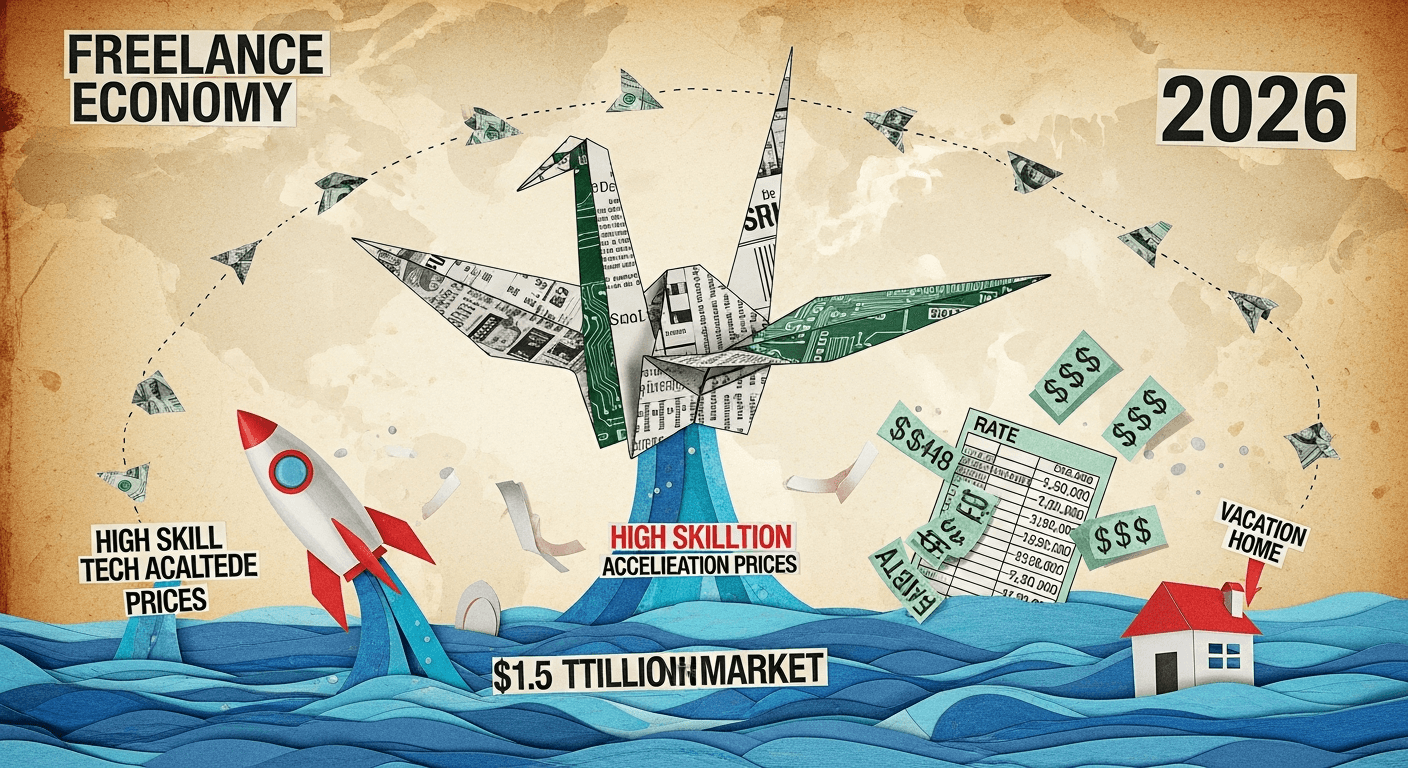
It’s 2026. We were promised flying cars and moon colonies. Instead, we got AI chatbots that can write poetry and a freelance revolution that’s absolutely crushing the traditional 9-to-5. Honestly? I’ll take the freedom over the flying car any day. If you’re reading this, you’ve likely joined the millions who realized that wearing pajama bottoms to a business meeting is the peak of human evolution. But with that freedom comes a terrifying question: how to set freelance rates in 2026 without undercutting yourself or scaring off clients?
Cue the sweaty palms.
Price yourself too low, and you’re basically running a charity for capitalism while eating instant noodles. Price yourself too high without the skills to back it up, and the silence from your inbox will be deafening. In an economy where the median freelancer is pulling in $85,000—often leaving their corporate W-2 buddies in the dust—getting your pricing right is the difference between a cute side hustle and a "buying a vacation home" career.
Whether you’re a Gen Z AI wizard, a corporate refugee turned consultant, or a creative finally charging what you're worth, understanding how to set freelance rates in 2026 is your new superpower. If you're just starting a freelance business, this couldn't be a better time - or a more crucial topic! For a detailed guide to actually getting started, see our "No-Nonsense Blueprint for 2026" found here: /blog/freelance-invoicing-templates-free-guide-2026.
Grab a coffee (or something stronger), open that terrifying spreadsheet, and let’s do some math.
The State of the Freelance Nation in 2026
Before we start throwing numbers around like we’re on the trading floor, let’s look at the big picture. You aren’t operating in a vacuum; you’re a shark swimming in a $1.5 trillion ocean.
The landscape has changed. High-skill fields (looking at you, AI and Tech) are driving rates up faster than my blood pressure during a play-off game.
Here is the reality of the market right now:
- Global vs. Local: The average global rate is around $28/hour. But in the U.S., it’s $48. In Western Europe, top-tier freelancers are commanding €100 averages. Dealing with international clients? You might need a Currency Converter to realize just how much you're actually making.
- The Skill Premium: We are seeing a "Great Bifurcation." If you do general admin tasks, it’s a cage match for rates. If you do specialized work—like fixing the mess an AI made of a company's finances—you can name your price.
- Inflation Adjustment: Rates are up about 11% year-over-year. Pro tip: If you haven't raised your prices since 2024, you’re technically paying your clients to work for them. Stop that.
The good news? 82% of freelancers see more opportunities in 2026. Clients have money, but they want value. Give it to them.
Benchmarking: What Are the Other Kids Charging?
One of the biggest mistakes freelancers make is guessing. It’s 2026, folks—we have data. You shouldn't base your self-worth entirely on what "Gary from Accounting" charges, but you should definitely peek at his homework to see where the bar is set.
1. Geography Matters (A Lot)
Where you live matters, but where your clients live matters more. This is the era of "geo-arbitrage." The goal? Live somewhere with $2 tacos, work for clients paying $50 rates.
Here is the breakdown of average hourly rates by region (USD):
- North America: $56 (The heavyweight champion)
- Western Europe: $27–$100+ (Highly variable; €100 is the new normal for experts)
- South America: $24
- Central & Eastern Europe: $23
- Asia: $20
Uncle’s Advice: If you are based in a lower cost-of-living area but working for a New York tech firm, for the love of all that is holy, do not charge your local rate. Charge $40-$50. You double your income; they think they’re getting a Black Friday deal. Everyone wins.
2. Industry Rates: The "Rich Niches"
Not all skills are created equal. In 2026, money follows complexity. If it hurts the client’s brain to do it, they will pay you handsomely to do it for them.
- Finance: $41/hour (Money people pay money for money help. Shocking.)
- Marketing: $34/hour
- Multimedia Production: $33/hour
- IT & Tech: $29/hour
- Project Management: $28/hour
- Programming: $25/hour
- Content Writing: $24/hour
Note: These are averages. Top-tier programmers and specialized writers (like the ones who understand medical jargon or crypto-compliance) charge 2x to 3x this. Be the specialist, not the average.
3. The Experience Curve
It’s natural to start lower. We all had to fetch coffee (metaphorically) at some point.
- 18–24 years old: $16/hour (The "I have energy and TikTok skills" tier)
- 25–34 years old: $19/hour
- 35–44 years old: $24/hour
- 55–64 years old: $36/hour (The "I’ve seen everything and I’m tired of your nonsense" premium)
A Note on the Gender Gap
Okay, taking the clown nose off for a second. This part frustrates me. The data for 2026 shows men are charging roughly 26.4% more than women globally ($52 vs. $37 in North America).
Ladies, if you are reading this: Statistically, you are likely undercharging. Stop it. You’re brilliant. Use these benchmarks, channel your inner mediocre-white-man confidence, and ask for the money. The market has it.
The Formula: How to Calculate Your Baseline Rate
Forget what the market says for a hot second. You need a rate that feeds you, pays the tax man, and maybe—just maybe—lets you retire before you're 95.
Unlike a corporate job, you don't get a 401k match or free breakroom donuts. You are the donut provider.
Here is the "No-BS" formula for your Minimum Acceptable Rate (MAR) when determining how to set freelance rates in 2026.
Step 1: Determine Your Desired Annual Salary
Let’s aim for the 2026 median: $85,000. If you were in a cubicle, this would be your gross pay.
Step 2: Add Your Overhead (The "Freelance Tax")
You have to cover self-employment taxes (the government will find you), health insurance, and software subscriptions. You can use a Sales Tax Calculator to figure out exactly what you owe the government, but you also need a buffer for the days you just want to lay on the floor.
- Rule of Thumb: Add 30% to 50% to your desired salary.
- $85,000 + 40% ($34,000) = $119,000 Total Revenue Needed.
Step 3: Determine Your True Billable Hours
Here is where rookies faceplant. You cannot bill 40 hours a week. You need time for admin, finding clients, crying over invoices, and eating lunch.
- Most full-timers bill 1,000 to 1,500 hours per year.
- Let’s be conservative/realistic and say 1,200 billable hours (about 25 hours of actual work per week).
Step 4: The Math
Total Revenue ($119,000) ÷ Billable Hours (1,200) = $99.16 per hour.
Your Rate: Call it a clean $100/hour.
Does that sound high compared to the $48 average? Maybe. But remember: the "average" includes people doing data entry while watching Netflix. You are running a business. If you want to make sure you're actually making money, run your numbers through a Profit Margin Calculator. Price for profit, not just survival.
Choosing Your Pricing Model: Hourly vs. Fixed vs. Retainer
You have your number. Now, how do you serve it to the client? In 2026, we’re moving away from trading hours for dollars (because time is finite, but your brilliance is infinite).
1. The Hourly Rate
- The Vibe: The Taxi Meter.
- Best for: Consulting calls, vague "I don't know what I want yet" projects, and building trust.
- The Trap: It penalizes efficiency. If you get faster, you make less money. That’s a bad game.
2. Project-Based (Fixed) Pricing
- The Vibe: The All-You-Can-Eat Buffet.
- Best for: Clear deliverables ("Build a Website," "Write 4 Blog Posts").
- Strategy: Estimate the hours, multiply by your rate, and add a 20% "Scope Creep Buffer" (because clients always want "just one more thing"). Once you agree, lock it in with a professional Free Invoice Generator so there's no confusion later.
- The 2026 Trend: Value-based pricing. If you can do a job in 10 hours that makes the client $50,000, do not charge $1,000. Charge $5,000.
3. The Retainer Model
- The Vibe: The Gym Membership (but hopefully they actually use it).
- Best for: Stability. Sweet, sweet stability.
- Strategy: A set monthly fee for set work.
- Why it rules: It cures the "feast or famine" panic. Plus, experts say you should save ~€1,136/month for retirement. Retainers make that math actually work.
5 Actionable Tips to Raise Your Rates in 2026
You have the number. You have the model. Now, how do you get them to sign the check without laughing?
1. Start High, Negotiate Down
It is infinitely easier to lower a price than to raise it. If you want $60, ask for $75.
- If they say "Yes" instantly, you played yourself. You were too cheap.
- If they negotiate, you drop to $60, they feel like they won a victory, and you still get your target. Psychology!
2. Sell Outcomes, Not Time
Clients don't care that you spent 4 hours on a logo. They care that the logo makes them look like a billion-dollar brand.
- Don't say: "I charge $50/hour to write."
- Do say: "I write email sequences that stop people from deleting your newsletter. The package is $1,500."
3. The "Portfolio Build" Tactic
New to a niche? Feel like an imposter? Use the "Beta Pricing" trick.
- The Script: "My standard rate for 2026 is $80/hour. But, I really want a case study in your specific industry. I’ll do this one for $50/hour if you promise me a glowing video testimonial and detailed feedback."
- This validates your "real" high rate while getting you in the door.
4. Specialize to Monopolize
Generalists fight over scraps. Specialists eat steak. "Marketing" pays $34/hour. "AI Marketing Automation Compliance" probably pays double. Find a painful, boring problem that rich companies have, and become the only person who enjoys solving it. Check out our Free Tools to help manage your specialized workflow.
5. Review and Raise Annually
The market moves fast. If you keep your rates the same as last year, inflation is slowly eating your lunch money.
- Action: Every January, send the email: "Due to increased demand and market adjustments, my rates are moving to [X]." It’s not personal, it’s business.
Professionalism Pays: The InvoiceCave Advantage
Listen, you can’t charge premium, "I-know-what-I'm-doing" rates if you send invoices that look like they were made in Microsoft Paint in 1998.
In 2026, the "vibe" is part of the product. High-paying clients expect a seamless experience.
- Tracking: Track your time. Even if you bill flat fees, you need to know if you're earning $100/hour or $4/hour internally.
- Presentation: An invoice isn't just a bill; it's a branding moment.
If you’re struggling to justify a rate hike, look at your admin. Do you look like a six-figure consultant, or do you look like you’re figuring this out as you go? Check out the InvoiceCave Blog for more tips on looking professional.
Conclusion
Learning how to set freelance rates in 2026 is a blend of art, science, and the audacity to believe you’re worth it. The market is booming. The money is there.
Don't let Imposter Syndrome drive the bus. It’s a terrible driver.
- Analyze the benchmarks (but don't obsess over them).
- Calculate your rate based on your life, not the average.
- Position yourself as the expert who solves problems, not the person who sells minutes.
- Use the right tools so you look the part.
The opportunity is there. The budgets are open. The only variable left is you.
Ready to look like the pro you are? Stop wrestling with messy templates and spreadsheets that make you want to cry. Check out InvoiceCave to create stunning, AI-powered invoices that get you paid faster and make your clients go, "Wow, this person has their act together."
Your rates are going up—make sure your invoicing keeps up. View our Pricing to get started.
FAQ: Setting Your Rates
How do I calculate my freelance hourly rate? To calculate your rate, take your desired annual income, add 30-50% for overhead (taxes, insurance, tools), and divide that total by your billable hours (usually around 1,200 hours/year). This gives you a Minimum Acceptable Rate (MAR) that ensures you are actually profitable.
How often should I raise my freelance rates? You should review your rates at least once a year. With inflation and your increasing experience, an annual increase is standard. You can also raise rates whenever you are fully booked or when you acquire a new, high-value skill.
Should I charge hourly or fixed rates in 2026? While hourly is good for vague consulting work, fixed (project-based) pricing is generally better for scaling your income in 2026. Fixed pricing rewards you for efficiency—if you finish the work faster, your effective hourly rate goes up.
What is the average freelance rate in 2026? The average freelance rate varies wildly by location and skill. In North America, the average is around $56/hour, while specialized tech and finance roles often command $100+/hour. Always research your specific niche rather than relying on global averages.
Bonus 2026: Pricing for the AI-agent era
The single biggest shift in freelance economics in 2026 is that AI agents are now your competition AND your leverage. Clients can ask Claude to draft a logo for free in 30 seconds. They can also ask Claude to manage their entire vendor pipeline, including paying you.
Two pricing implications:
1. Charge for outcomes, not hours
If a junior could prompt their way to your output in an hour, your hour is no longer worth $150. But the outcome — a working brand identity, a finished landing page, a launched campaign — is still worth $5,000+ to the client. Move every billable line item up the value chain.
Reframing your invoice line items:
| Old (hourly) | New (outcome) |
|---|---|
| 12 hours of design work | "Brand identity package — logo, type system, color palette, brand guidelines PDF" |
| 8 hours of dev work | "Customer onboarding email automation — 6-email sequence, tested, deployed" |
| 5 hours of consulting | "Q1 GTM strategy — competitive map, ICP definition, 90-day roadmap" |
Outcome-based line items are harder to AI-arbitrage because the client is paying for your judgment, not your time.
2. Use AI yourself to bill faster
The freelancers winning in 2026 are the ones who use AI to do the unbillable work — admin, follow-ups, invoicing — so 100% of their billable hours actually pay. InvoiceCave's MCP integration lets Claude Desktop or Cursor handle your billing in plain English: "Bill Acme $4,200 for the rebrand, modern template, Net 30, email it now." 30 seconds, done. No clicks.
Read more: Invoice from Claude Desktop in 30 seconds.
Real freelancer math: what 2026 rate increases look like
Here's what a typical freelance rate increase looks like in 2026 inflation-adjusted terms:
| Specialty | 2024 typical | 2025 typical | 2026 floor | 2026 above-average |
|---|---|---|---|---|
| Junior copywriter | $50/hr | $60/hr | $75/hr | $120/hr |
| Brand designer | $90/hr | $110/hr | $135/hr | $200/hr |
| Senior developer | $120/hr | $150/hr | $180/hr | $275/hr |
| GTM consultant | $200/hr | $250/hr | $300/hr | $500/hr |
Three things drive the "floor": cumulative inflation (~14% over 2024–2026), AI commoditization at the bottom (pushes the floor UP because anyone below it is getting replaced), and discounted-rate tax (you pay more in self-employment + healthcare than ever).
If you're under the floor, you're losing money to inflation alone. If you're at the floor, you're staying flat. Anything above is real raise.
Annual rate-review checklist
Once a year, do this:
- Calculate your true effective hourly rate. Take last year's revenue. Divide by actual billable hours (be honest — admin doesn't count). If that number isn't 2× your nominal rate, your nominal rate is too low.
- Survey 3 peers. Quick DMs. "What are you charging right now for X?" Most freelancers undercharge by 30–50% relative to peers — they just don't ask.
- Raise existing clients in writing. "Effective Jan 1, my rate moves from $X to $Y. New work after that date will reflect the new rate." Polite, no apology.
- Run the new rate through your invoicing setup. Update your default tax/discount/templates in InvoiceCave so every new invoice already has the right number.
The freelancers who run this checklist annually outperform the ones who don't by 2–3× over five years. Compounding rates.
Related reading
- InvoiceCave MCP — 102 tools for Claude, Cursor & AI agents — connect any MCP-compatible AI client and run your billing in plain English.
- Use InvoiceCave in Claude Desktop — 30-second setup guide.
- The 7 Best Invoicing Software for Freelancers in 2026
- The Ultimate Guide to Recurring Invoices: How to Set Them Up
- How to Invoice Clients as a Freelancer: The Ultimate Guide for 2026
Ready to simplify your invoicing?
Create professional invoices in seconds. Free to start.
Get Started Free